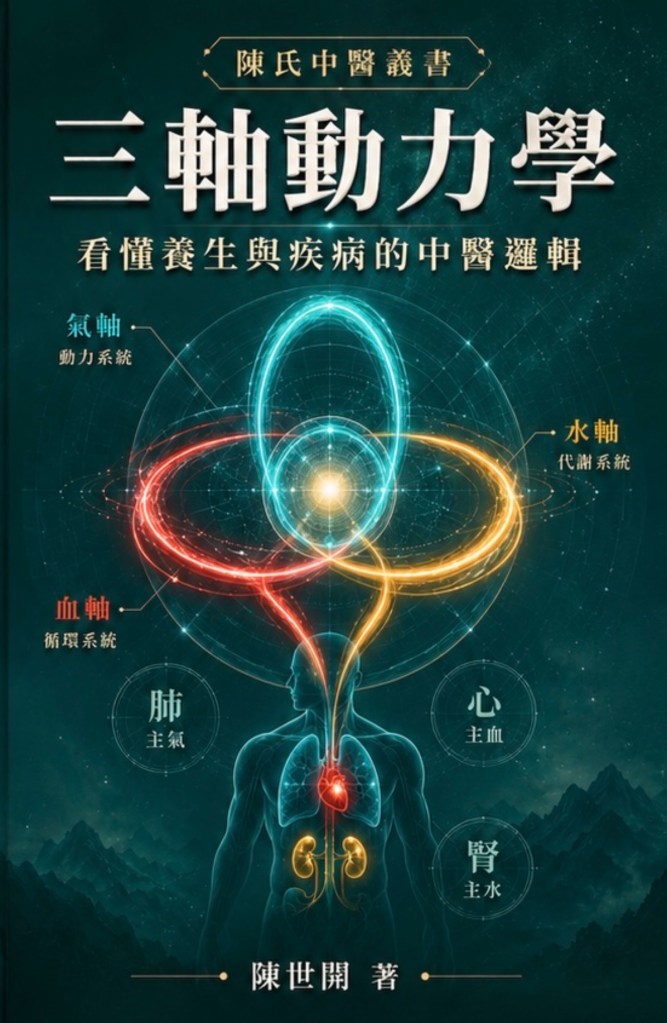
A Comprehensive New Theory of Traditional Chinese Medicine

Three-Axis Dynamics is a comprehensive medical theory based on traditional Chinese medicine, developed by Professor Chen Shikai, a Canadian practitioner of traditional Chinese medicine, through many years of clinical research, teaching, and practical verification.

It is not merely a classification of diseases into three types—Qi, Blood, and Body Fluids—nor is it simply another form of pattern differentiation; rather, it is a comprehensive and coherent theoretical system of Traditional Chinese Medicine that encompassesTheory, Physiology, Etiology, Pathogenesis, Differential Diagnosis, Diagnosis, Treatment Methods, Prescriptions and Medicines, Acupuncture,Health Preservation and Clinical Applications, thereby establishing a comprehensive framework that spans from fundamental theory to clinical treatment.

The most distinctive feature of the Three-Axis Dynamics is that it applies a single set of core principles throughout the entire system of Traditional Chinese Medicine, allowing diagnosis and treatment to flow naturally from one to the other and truly achieving the integration of diagnosis and treatment.

The three axes influence one another

The human body is not three separate systems, but a single, interconnected whole.

Therefore, a disease is often not a problem confined to a single system, but rather the result of the three axes becoming imbalanced and influencing one another. For example, chronic stress can lead to Qi stagnation; Qi stagnation affects circulation, leading to blood stasis; and as blood circulation deteriorates, it in turn affects fluid metabolism, ultimately resulting in phlegm-dampness and chronic diseases.

Three-axis dynamics identifies the true root causes of disease by analyzing the relationships among the three axes, rather than merely treating superficial symptoms.

Chen Shikai | Senior Traditional Chinese Medicine Practitioner in Canada
D.TCM, R.TCMP, R.Ac

Integrated Diagnosis and Treatment | Complete Correspondence Between Tongue, Pulse, Symptoms, and Prescriptions

The three-axis dynamics establish a highly consistent clinical diagnosis and treatment system.

From tongue diagnosis and pulse diagnosis to pattern differentiation, treatment principles, selection of herbal formulas, acupuncture prescriptions, and health recommendations—all are based on the same three-axis theory.

Truly achieve:

Therefore, rather than memorizing a vast amount of scattered knowledge, one can use a single framework of thinking to understand the development of diseases, determine their location and nature, and formulate a comprehensive treatment strategy.

A medical system that can be studied, passed down, and applied in clinical practice

Three-axis dynamics encompasses a comprehensive medical framework:

  • Three-Axis Theory
  • Pathogenesis and Pathomechanisms of the Three-Axis Theory
  • Three-Axis Differentiation
  • Three-Axis Tongue Diagnosis
  • Three-Axis Pulse Diagnosis
  • Three-Axis Treatment Method
  • Three-Axis Traditional Chinese Medicine
  • Three-Axis Acupuncture
  • Three-Axis Curing
  • Three-Axis Pathology

From health management and disease prevention to clinical diagnosis and treatment, the same theoretical framework underlies all these areas, forming a comprehensive, systematic, and highly consistent new school of thought in traditional Chinese medicine.